
Terrell County Court Calendars Explained
Terrell County court dates turn up in four different places. A file docket at the clerk's office may list a notice of setting, a reset, or a continuance. It may also list a hearing or a trial. Online, the shared Val Verde County calendar splits into separate categories for the 63rd and 83rd District Courts. It has carried events labeled for Terrell County. The district coordinator keeps the current setting for those courts. Closer to home, the combined District and County Clerk and the two Justice of the Peace offices confirm county-level and justice settings.
Why the split? The local clerk sits in Sanderson. Both multi-county district courts run out of Del Rio. The 63rd District Court covers Kinney, Terrell, and Val Verde Counties. The 83rd handles Pecos, Terrell, and Val Verde Counties. So a docket entry or calendar item hosted on a Val Verde web address can still be a real Terrell County setting. Where the calendar lives tells you nothing about where the case belongs.
Terrell County Shared Calendar Controls
The shared calendar gives you three views: List, Week, and Month. A selector lets you pick feeds for the 63th District Court, the 83rd District Court, the County Clerk's Calendar, District Clerk's Events, and JP1 through JP4. Print, Notify Me, and iCalendar subscription buttons sit alongside them. There is no name or case-number search. A docket search here means choosing the right category and a sensible date range before you scan for a hearing.
The official historical calendar shows exactly what a public event entry can include. Each item lists a title, a category, a date, a time or time range, a location when one is supplied, and a More Details link.
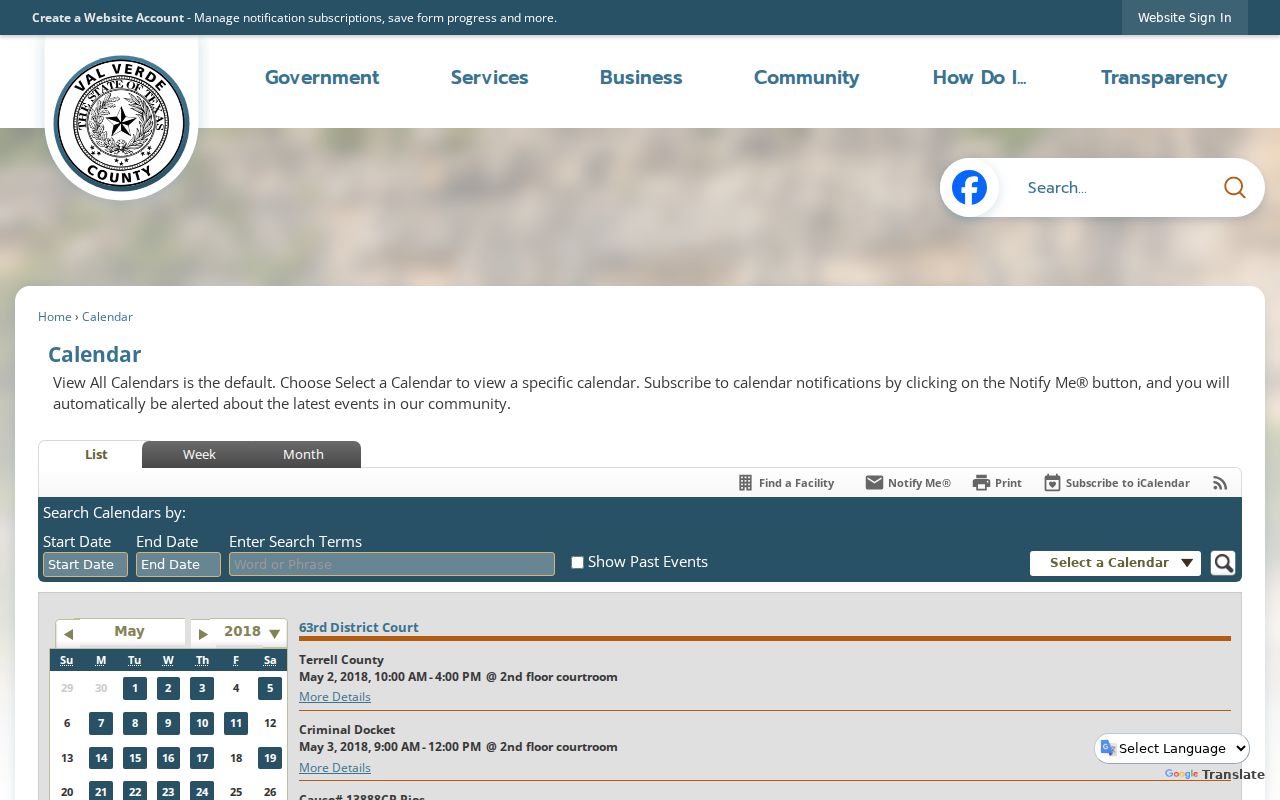
That archive example is useful for one thing. It shows how district settings get grouped on the calendar. It cannot tell you when or where to appear for a current Terrell County court date, so check the live calendar or the coordinating office before you rely on it.
Finding Your Court Date
Start with the strongest notice you hold, whether that is a setting letter, a reset entry, or a trial date on the docket. Then check what the online sources say against the office that actually controls the setting. Every channel here does a different job.
- Read the citation, summons, order, or notice for the court name, case number, date, time, and place.
- Check iDocket for a notice of setting, hearing, reset, continuance, trial, or disposition in the file docket.
- For a district case, choose the 63rd or 83rd category in the shared calendar and use List view near the stated date.
- Call the 63rd coordinator at (830) 774-7523 or the 83rd coordinator at (830) 774-7654 to confirm a district setting.
- For County Court, call the combined clerk at (432) 345-2391 or ask at 105 East Hackberry Street in Sanderson.
- For a justice case, call JP Precincts 1 and 2 at (432) 345-2341 or JP Precincts 3 and 4 at (432) 345-2660.
Your lawyer, if you have one, may hold the signed order or the latest scheduling notice. Trial dockets are sometimes posted at the district courtroom door. That practice runs under the 63rd District Court rule. The clerk's office offers no public terminal or printed daily Terrell County calendar, though. Call ahead before you drive over. A counter computer or paper sheet is not guaranteed. A quick phone check can save you a wasted trip.
Terrell County's 10 A.M. Docket Call
One detail sets Terrell County apart. An official 63rd District Court rule fixes docket call at 10:00 a.m. here. Written notice can say otherwise. Other counties served by the same court get earlier calls under that same rule. So read the county name on your setting as closely as the court number. The hour can hinge on it.
Docket call in Terrell County is a session where the court calls each matter. It takes appearances or announcements. It is not automatically the start of a full hearing or trial. If a written notice for your specific case says something different, that notice controls. A quick confirmation with the court coordinator is the safest final check. Make it before you rely on any listed court date.
How to Read a Court Setting
A calendar line is a compact scheduling record, nothing more. Check it against the case number and your written notice before you act on it. That matters most when a title is broad or one event covers a full docket.
| Date | The day assigned to the event; confirm that it is current rather than an archived term. |
|---|---|
| Time | The start of the calendar block or an individual hearing. A docket call can cover several matters. |
| Courtroom | The stated room or building. Historical entries have used a second-floor courtroom, but current notice controls. |
| Judge or court | The 63rd or 83rd District Court, County Court, or the specific JP office that owns the setting. |
| Setting type | A docket call, final pretrial, bench trial, jury trial, criminal or civil docket, mediation, or another event. |
The entry you see may leave out the parties and the attorneys. A later order, a coordinator notice, or a fuller docket entry can carry the complete style and cause number for the case.
Terrell County Court Date Labels
Calendar labels in Terrell County describe what the court plans to do. They say nothing about how the case ends. Knowing that keeps a docket block from being read as a final trial date when it is really just a setting.
- Criminal Docket
- A call or grouped listing of criminal matters set before the court.
- Civil Docket
- A grouped setting for civil cases; some listings combine civil and criminal matters.
- Final Pre-trial
- A hearing used to address readiness and remaining issues before trial.
- Bench Trial
- A trial set for decision by the judge rather than a jury.
- Jury Trial
- A trial setting involving jury scheduling; the clerk also administers the county jury-selection process.
- ADR Mediation
- A calendar label for an alternative dispute resolution session.
Grand Jury has shown up as a label on the 83rd District Court calendar too. That wording does not mean protected grand-jury material is open to the public. For more context tied to a cause number, try the Terrell County case lookup.
Continuances, Resets, and Cancellations
A reset simply moves the scheduled date. A continuance pushes the proceeding back by agreement or by court order. A cancellation can strip an event off the calendar. A disposition, a dismissal, a conflicting setting, or a later order may have made it unnecessary. One wrinkle worth knowing: the file docket may record the change. An older public calendar view can still show the first date. The 63rd District Court publishes a rule on this. A case set by written order or administrative notice generally stays on the docket unless one of a few things happens. The court must receive an approved written Motion for Continuance filed five days before the setting. Otherwise the parties must file a written mutual agreement. A dismissal or an agreed final disposition filed with the clerk also works, as does another permitted disposition. Keep in mind that a filed motion alone proves nothing. The setting has moved only once the court approves it, so confirm with the coordinator.
Terrell County Coordinator Confirmation
The shared calendar, iDocket, and the coordinator each serve a different purpose here. Don't treat one as a backup for the others. iDocket's own help notes that case history may lack hearing and court-calendar dates, since coordinators or court administrators keep that information. Also note that a shared-calendar entry can stay visible as historical evidence even after the live schedule has changed.
Use the authority chain. Read the signed or issued notice, compare the docket and shared calendar, then confirm the current setting with the court coordinator or responsible JP office.
Terrell County posts no standing Zoom or hybrid-hearing policy. Treat any remote link that turns up in an email or an old calendar item as unconfirmed. The coordinator's office must check it first. A statewide permission to hold remote hearings does not reach this far. The Terrell County setting you face may still be in person.
If You Miss a Court Setting
Call the court that owns the case right away. Have the case number, your name, the missed date, and the kind of setting handy. Ask three things. Whether an order issued, whether a new date exists, and what the court wants from you next. The combined clerk can pull a County, 63rd, or 83rd file. Scheduling in the district courts, though, runs through the coordinator. For a justice-court matter, contact the JP named on the citation or case paper.
Act promptly. A missed criminal or traffic setting may lead to a failure-to-appear consequence, warrant, or bond issue, while a civil nonappearance may produce an adverse order.
Call the court or your attorney before appearing without a confirmed date or instruction.
A licensed attorney can advise how to address a missed Terrell County setting and any order already entered.
One more wrinkle comes from the 63rd District Court. Its rules permit dismissal for want of prosecution. That applies when nobody appears or announces in a set case. What actually happens turns on the court, the case type, any orders, and the facts. An old online date proves nothing about the outcome. Ask instead for the latest docket entry or order.